|
Hysterectomy is a surgical operation to remove the womb.
Why?
Generally speaking, it is used for the following conditions:
- Fibroid or recurrent polyps.
- Heavy & painful periods when other treatments have failed.
- Cancer of the womb, cervix (neck of the womb) or ovaries.
When is hysterectomy suitable?
In fibroid condition, it is only suitable when:
- You want a permanent solution to your fibroid problem.
- You no longer want to have children or near or pass menopause.
- The fibroids are large and cause heavy bleeding.
- All other alternatives for fibroids have failed.
How many types of cuts are there?
In terms of the different types of cut (incision) to access the womb, there are 3 types:
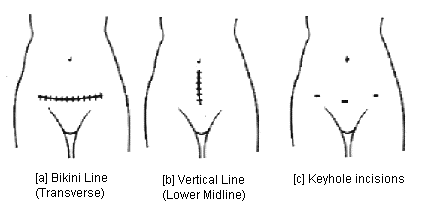
- Open abdominal: either bikini or vertical line. Scar as a line of 10-15 cm.
- Vaginal. No visible scar.
- Vaginal with laparoscopy (keyhole). Three to four scars of about half-inch each.
When is a vaginal hysterectomy not suitable?
Vaginal hysterectomy may NOT be recommended if you have large fibroids or have had a previous operation such as a caesarean delivery.
What are the risks & complications of hysterectomy?
Like all surgical procedure, hysterectomy carries short-term and long-term risks (see Tables 1 & 2).
| Table 1. Summary: Short-term Risks of Hysterectomy |
| Infection |
Infection of the bladder, chest, abdomen may necessitate you to return to the hospital for antibiotic treatment. Wound infection may also occur. |
| Urinary problems |
Kidney/bladder infection or urinary incontinence. The risk is higher for radical hysterectomy. |
| Blood clots |
Can happen in the veins in the leg (DVT) or pelvis. The risk is increased by smoking, inactivity, excess weight and oral contraceptives. |
| Haemorrhage |
Excessive blood loss during or after the operation which requires blood transfusion. |
| Adverse reactions |
Nausea/vomiting can occur due to anaesthetics. |
| Adjacent organ perforation |
This can happen to the bowels, bladder or urethra. If perforation occurs, you may have to undergo another operation to remove adhesions. |
| Table 2. Summary: Long-term Risks of Hysterectomy |
| Urinary Incontinence |
Small risk following damage to the pelvic nerves. |
| Early menopause |
Occurs when the ovaries are removed. This also happens when there is no removal of ovaries in women who were not yet menopausal prior to surgery, due to the decrease in blood flow to the ovaries after hysterectomy. |
| Lack of orgasm |
Occurs when the cervix is removed. |
| Prolapse. |
Intestines and bladder can descend towards the bottom which can lead to constipation and/or urinary incontinence/inability to control bladder and pain in sexual intercourse. |
| Mood |
Depression/sadness due to a feeling of losing your femininity. |
What are the risks/side-effects of anaesthetics?
The risks of anaesthetics depend very much on your general health. A fit, healthy 20 year old person would be at far less risk than an 80 year old person would with some serious disease.
| Table 3. Possible risks of anaesthetics |
| Nausea and Vomiting |
Not always occur. May also be caused by the surgical procedure or pain relief medication. Medications and fluids may be required.
This may be from a tube in the mouth or throat during anaesthetic. Cough lozenges, gargle, simple pain killer may help. |
| Muscle weakness |
Muscle pain may be from spasm around the wound or the use of certain anaesthetics. Pain killers and rest usually settle it. |
| Blurred or Double vision |
Usually settles down with rest. |
| Post operative pain |
This is due to cuts in your skin and tissues. Resolve with painkillers and anti-inflammatory. |
| Allergic reactions |
Your anaesthetist will avoid any known drugs that you know you are allergic to. In case of unexpected reaction, the team is well trained and qualified to deal with it. |
| Damage to teeth |
Once you are deeply asleep, tubes may be placed inside your mouth and throat. The shape of your mouth varies and different types of dental diseases, loose teeth, bridge and crowns may be present.
The anaesthetic talks about possible damage to you before the operation. If damage occurs, you will be told about it afterward and repair is arranged. |
What is the alternative to general anaesthetic?
The alternative involves an epidural injection that blocks feeling from the waist down, plus sedation to relieve anxiety and help you to relax. You will stay awake during the operation.
How do I prepare?
- If you smoke, you will be asked to stop. Smoking increases your risk of getting a chest and wound infection, which can slow your recovery.
- If you are using oral contraceptives, you are required to stop OC 4-6 weeks before the operation and use condom instead.
- You must drink only fluids in the evening before the operation day and not eat or drink anything on the day of the operation. You will be given clear instructions about fasting times with your appointment letter.
Generally speaking, you are required not to eat or drink for at least six hours before a general anaesthetic. some anaesthetists may allow occasional sips of water until two hours beforehand. Check with hospital first to make sure if this is ok.
What happens BEFORE the procedure?
A few weeks before the operation, a pre-operative check is carried out to ensure that you are fit for the surgery and anaesthetics which include:
- Pregnancy test.
- Medical history including what medications you take regularly.
- Check blood pressure, heart rate and ECG to see if the heart is fit.
- Blood test to check for haemoglobin level and "cross matching" in case you require blood transfusion either during or after the operation.
You will normally come into the hospital either on the day of your operation or the day before.
What happens ON THE DAY and BEFORE the procedure?
- You will be taken to a waiting room where a nurse will check you in.
- You will be seen by the gynaecologist who explains the procedure to you and allows you a chance to ask any questions related to the operation.
- For open abdominal hysterectomy, your surgeon will discuss with you whether a cut across your lower abdomen just below your bikini line is feasible. If you have large fibroids in your womb, a cut from your belly button down to your bikini line may be necessary.
- An anaesthetist will meet you to go though the type of anaesthesia applicable for your case and ask questions about history of your previous operation(s) if you've had any and your family's.
Also, he/she will give you warnings on possible risks/side-effects (see above).
Don't forget to mention any side-effects you or your family had ever experienced with anaesthetics.
- Your anaesthetist will also explain pain control programs during and after the surgery.
- You will be asked to sign a consent form. You sign this form once you clearly understand the risks, benefits and possible alternatives to the procedure. By signing the consent form, you give permission for it to go ahead.
- You may be asked to wear compression stockings to help prevent blood clots forming in the veins in your legs.
- An hour before the operation, you will be taken to the pre-op room where you are fitted with an intravenous line for "pre-med" to be given to relax and sedate you.
- You will be moved to the operating theatre.
What happens DURING the operation?
- The anaesthetist will put you to sleep by starting the relevant anaesthetic program.
General anaesthetic is used for most hysterectomies. Occasionally, a spinal or epidural anaesthetic is used and you are also given a sedative.
- What happens next depends on your health and the type of cut (incision) used.
Generally speaking, to access the womb, either one of three types of cut is carried out as shown in Figure 1. Your scar(s) will also look like that.
- Your surgeon will remove your womb as described in Table 4.
| Table 4. Types of Hysterectomy Incision |
| Description |
How is it done?
|
| Abdominal |
Hospital stay: several days, up to 5 days.
The womb is removed through a 10 - 15 cm incision in the abdomen. The incision is either a horizontal line under the pubic hair line (also known as "bikini") or vertical between the pubis and the navel. Your womb is taken out via this cut (incision). Stitches (may be dissolvable) or metal clips will be used to close the cut on your abdomen and the area will be covered with a dressing.
|
| Vaginal |
Hospital stay: short.
Recovery period: up to 8 weeks.
Specially designed instruments will be passed through your vagina. A small incision in the rear of the vaginal is made to remove the cervix and the womb. The top of your vagina will be closed using dissolvable stitches. A tampon-shaped dressing (sometimes known as a pack) may be left in your vagina to apply pressure to stop any bleeding. You will have no visible cuts or scars.
|
| Vaginal with laparoscopy |
Hospital stay: short, about 1 to 2 nights.
Recovery period: 3 to 6 weeks.
A tiny cut is made in the navel (belly button) and a thin laparoscope (telescope) is passed through it into the abdomen (tummy).
The laparoscope is connected to a monitor so that the inside of the abdomen can be seen by the surgeon.
One to three small cuts are made (about half-inch in size) to allow narrow instruments to be passed into your abdomen. The total number of cuts is between 2 to 4.
Watching on the monitor, the surgeon removes the womb (and sometimes the ovaries) through a cut in the vagina. When complete, the surgeon closes all the cuts with dissolvable stitches.
|
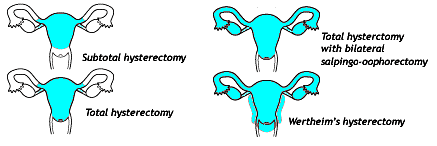
- Depending on the type of hysterectomy, some other parts of your reproductive system may be removed at the same time (Table 5).
The diagram below shows what is removed in each type of hysterectomy as shaded areas:
| Table 5. Types of Hysterectomy |
| Type |
What removed |
What remains |
Comments |
| Sub-total (partial) hysterectomy |
Uterus |
cervix, vagina, fallopian tubes, ovaries |
Must continue cervical smears afterwards. |
| Total hysterectomy |
Uterus and cervix. |
Fallopian tubes, vagina and ovaries. |
|
| Total hysterectomy with salipingo-oophorecting |
Uterus, cervix, fallopian tubes and ovary. |
Vagina and 1 ovary if the Bilateral procedure is NOT in use (see note in the comments). |
If both ovaries are removed, it is called bilateral procedure. |
| Radical hysterectomy (Wertheim's) |
Uterus, cervix, top part of the vagina & supporting tissue, pelvic, lymphatic nodes. |
Ovaries |
This procedure is only carried out in the case of invasive gynaecological cancer. |
- The time taken for the procedure varies depending on reasons and type of hysterectomy. Typically, it takes between 1-2 hours for a keyhole hysterectomy and around 1 hour for an open abdominal hysterectomy and a similar time for a vaginal hysterectomy.
- When the operation is over, the anaesthetist will bring you back to consciousness.
What happens AFTER the procedure?
- You will be taken to the recovery room where you're given oxygen and monitored until you gain full consciousness from anaesthetics. You will continue to feel drowsy and weak for a little while.
Specially trained nurses will care for you in the recovery room. When you are stable, you are then moved to the ward.
- When you wake up from the operation, you will notice that you have the followings:
- An oxygen mask to help you breathe.
- A drip in the arm to give fluids, blood, plasma.
- A temporally bladder catheter. . The urinary catheter will be removed within 48 hours once you are able to make yourself to the toilet.
- One or two drains from the wound if you have open surgery to prevent blood from collecting in the wound and causing an infection. They are usually removed within 2-3 days.
- A pain relieve pump:
Either a PCA (patient controlled analgesia)- a handheld device where you can press every time you want to give yourself a dose of the pain killer.
Or an epidural pump which delivers the pain killer via your back.
- You will feel extremely tired and sleepy, particularly after general anaesthetic.
-
The PCA for pain relief will be discontinued within 48 hours and you will be given oral pain killers (paracetamol, diclofenac, dihydrocodeine or morphine).
- For the next few days, you may be given anticoagulant injection to prevent DVT such as Clexane.
- You may find that you don't have any bowel movements for a few days after the operation. Tell your nurses as soon as you pass wind or a bowel motion because this shows that your digestive system is getting back to normal. If you do not open your bowel after 3 days, you will be given suppositories to help.
- You will be given advice about getting out of bed, bathing and diet.
- A physiotherapist will show you how some exercise you can do to speed up your recovery.
- The clips or un-dissolvable stitches will normally be taken out before you go home. Dissolvable stitches usually take 2-3 weeks to disappear depending on the type, but it can be longer.
What are the self-care tips while I am in the hospital?
Your self-care guide in the hospital involves:
| Table 6. Inpatient Self-care Tips |
| Time post-operation |
What to do |
| First day post-op |
Start drinking small sips of water to kick starts your gut into working. |
| Sit up right, especially out of bed. This helps to prevent chest infection. |
| Start moving round. Wear your TED socks to help to prevent DVT. |
| From second day to discharge time (5 to 6 days) |
Try to move around more and become independent. Drink plenty of fluid & walk around to help your bowel working again. |
| Do pelvic floor exercise per instructions from the physiotherapist. |
Going home....
Depending on your speed of recovery, you are going hone within:
- 2 to 4 days after vaginal hysterectomy.
- 3 to 5 days, in some cases up to 7, after abdominal hysterectomy.
- 1 or 2 nights after keyhole hysterectomy.
Your nurse will advise you about caring for your wounds, if applicable. You will normally be given a follow-up appointment to be seen in the outpatients’ clinic in 3 months’ time.
Care At Home Guide
- The pinkish/brown vaginal discharge continues for 10-14 days post-op. This is normal as part of the healing process.
- Carry on with pelvic floor exercise per instruction from the physiotherapist.
- Most importantly, if applicable, keep the wound (incision site) clean and dry. There is no need to put any dressing over it. Apply daily dry antiseptic spray such as
Savlon Dry Antiseptic or Betadine Dry Spray (you can buy from pharmacy). The key objective here is to avoid infection for healing to take place.
- A DO and DON'T list (Table 7) is compiled for you as a guide, as always, use your common sense as well.
| Table 7. DO and DON'T List |
| Time post-op |
DO |
DON'T |
| Week 1 to 2 |
- Use sanitary towels instead of tampons.
- When you have a bath or shower, use only unscented bath/shower gel or soap around the wound area.
- Pat dry your wound afterwards.
- Avoid vaginal lubricant, gel or cream.
- Start gentle walking around the house in week 1.
|
- DON'T lift anything heavier than a full kettle.
- DON'T drive.
- DON'T have sexual intercourse.
|
| Week 3 to 5 |
- Gently increase your physical activities.
- Allow rest time throughout the day.
- Start short walk in week 2.
|
- DON'T put anything inside your vagina.
- DON'T drive.
- DON'T have sexual intercourse.
|
| Week 6 Onwards |
- Resume light work.
- If you have no pain, you can start driving. If in doubt, see your GP.
- You can start sexual intercourse if you have no pain or vaginal bleeding. If you experience pain or bleeding after sex, contact your GP for advice.
- Start driving if you are confident to handle the car.
- Return to heavier work and all activities without restrictions in week 10.
|
|
- A full recovery may take between 6-12 weeks.
When should I seek emergency medical attention?
While it is unusual to have problem once you are at home, seek immediate medical attention if any of the following occurs:
- Nausea and vomiting.
- Severe and increasing pain.
- Increased red blood/clots bleeding from the vagina.
- Foul-smelling vaginal discharge (yellow/green colour).
- Discharge from wound or wound opening.
- Burning pain when passing urine.
- Difficulty or unable to pass urine.
- Pain, swelling or redness in the calf.
|
 Woman2Woman Fibroid Support


 This site complies with the HONcode standard for trustworthy health information:
  Print Friendly Page